Welcome to the AI4NGOs Platform
- 00902126217973
- İstanbul, Türkiye
- info@ai4ngos.org


Welcome to the AI4NGOs Platform

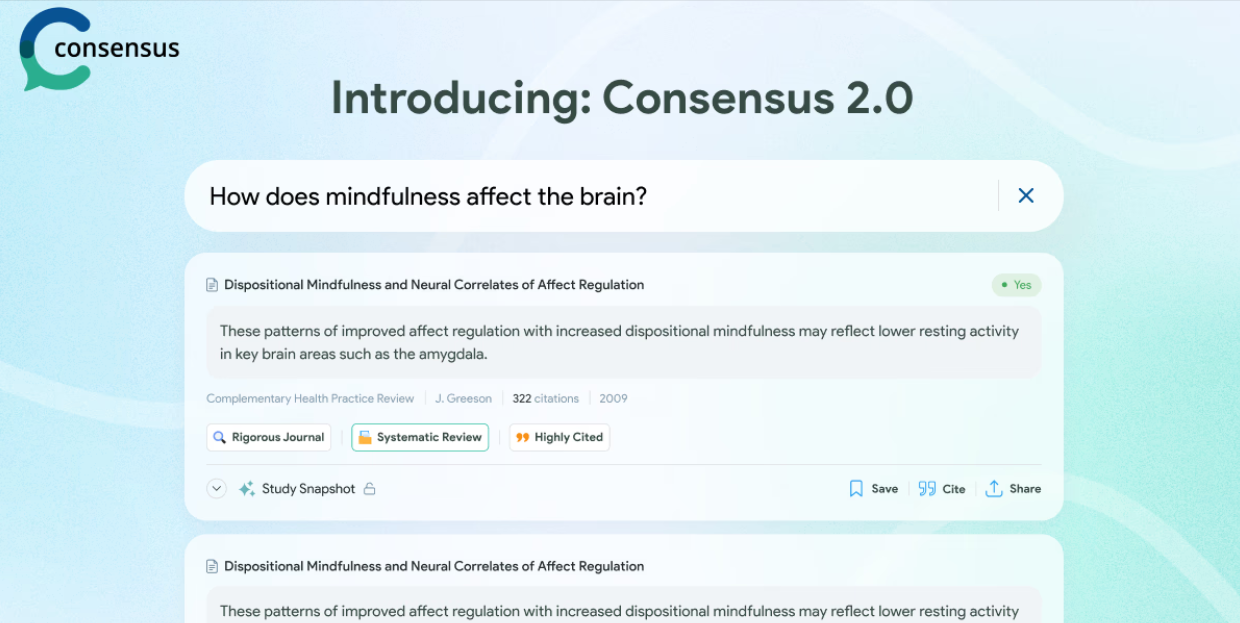
Consensus is an AI-powered research engine designed to extract evidence-based conclusions from peer-reviewed scientific literature. It indexes a wide range of academic papers and uses advanced language models to read studies and summarize findings, showing whether the evidence supports, opposes, or remains inconclusive about a given claim. Users can search by asking a direct question and receive scientifically sourced answers.
The platform shortens the time needed to locate credible research by integrating search, screening, and critical reading into one interface. Its focus on peer-reviewed papers enhances the reliability of its outputs, making it valuable for teams that rely on precise, evidence-grounded information.
Consensus helps humanitarian researchers quickly access scientific evidence related to public health, mental health, food security, child protection, social interventions, and crisis response. Instead of navigating hundreds of papers, teams can instantly see whether a scientific consensus exists on key topics, supporting stronger contextual analysis and program design. It is particularly useful for drafting advocacy briefs, situation analyses, and donor-oriented reports, as it provides neutral, citation-based summaries that enhance credibility. It also helps teams follow scientific developments in areas such as WASH, nutrition, epidemics, education, and cash programming effectiveness, ensuring that programs remain aligned with global research trends.
Consensus excels at converting peer-reviewed findings into concise summaries backed by citations, saving significant time in research-heavy workflows. Its “evidence-first” approach provides clarity on whether studies agree or conflict, instead of offering long lists of links. The interface is intuitive, search is straightforward, and sources are transparent. It delivers high-relevance results by filtering only peer-reviewed papers, improving reliability. The tool handles complex research questions and provides a strong sense of the strength and direction of available evidence, making it helpful for humanitarian policy and programming.
Some humanitarian-specific topics may have limited coverage if few studies exist. The free plan is restricted, while more advanced features require a paid subscription.
Without Consensus, accessing reliable scientific evidence becomes slower and more manual. Teams lose the ability to quickly assess the direction of research and would need to spend far more time screening studies individually, which affects the quality and speed of evidence-based decision-making.
Free basic version – paid plans around 19–29 USD/month.