Welcome to the AI4NGOs Platform
- 00902126217973
- İstanbul, Türkiye
- info@ai4ngos.org


Welcome to the AI4NGOs Platform

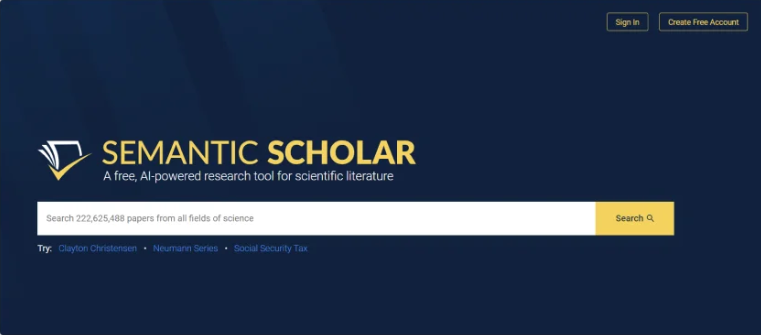
Semantic Scholar is an AI-driven academic search engine developed by the Allen Institute for AI (AI2). It helps researchers discover relevant scientific literature by using natural language processing and machine learning to understand the meaning behind papers and highlight connections, rather than relying purely on keyword matching. The platform indexes hundreds of millions of academic papers across a wide range of disciplines.
One of its key strengths is the ability to intelligently summarize research papers. Semantic Scholar applies AI techniques to extract essential parts of a paper such as tables, figures, citations, and core insights, which greatly accelerates comprehension and allows users to quickly grasp the main ideas of a work.
n humanitarian contexts, Semantic Scholar can provide teams with a strong evidence base on critical issues like public health, displacement, protection, and recovery. Researchers and MEAL teams can quickly access peer‑reviewed studies, enabling them to ground their analysis and program designs in up-to-date and credible science. Organizations working on policy or advocacy can use the tool to identify impactful studies and trace how certain social, health, or conflict-related variables are connected in the literature. This allows them to build interventions or policy briefs that are backed by rigorous academic research. Because the platform is free, it is especially valuable for resource-constrained NGOs that need serious research capacity without paying for expensive academic databases. Staff can also be trained to use it to conduct literature reviews by starting with TLDR summaries, which reduces the time spent reading full papers while ensuring that key findings are not missed. By building and curating a personalized “library” of relevant papers in Semantic Scholar, humanitarian teams can stay up-to-date with emerging evidence and quickly revisit studies when they’re designing new interventions or writing reports.
Semantic Scholar uses AI to understand semantics (meaning) in research papers, not just keywords, which helps it identify deeper connections between studies. It provides TLDR-style summaries, and with the beta version of Semantic Reader, users get contextual citation cards and highlighted key points, making reading more efficient. The adaptive research feed (“Research Feeds”) recommends new papers based on users’ libraries. There is also a free API, allowing developers or research teams to integrate Semantic Scholar into custom tools and workflows.
Some papers may not be fully accessible if they are behind paywalls, limiting how much of the content users can read. The Semantic Reader is still in beta, so its features are not always fully stable or available. Recommendation feeds require some time and effort to personalize effectively, especially in the beginning.
Without Semantic Scholar, you'd miss out on a powerful, AI‑powered academic search engine that connects you to a vast corpus of scientific literature for free. You would likely rely on traditional search tools with less semantic understanding, which makes discovering relevant studies slower, more cumbersome, and less precise. This could slow down research, weaken evidence in reports, and make literature reviews more laborious and fragmented.
Free